

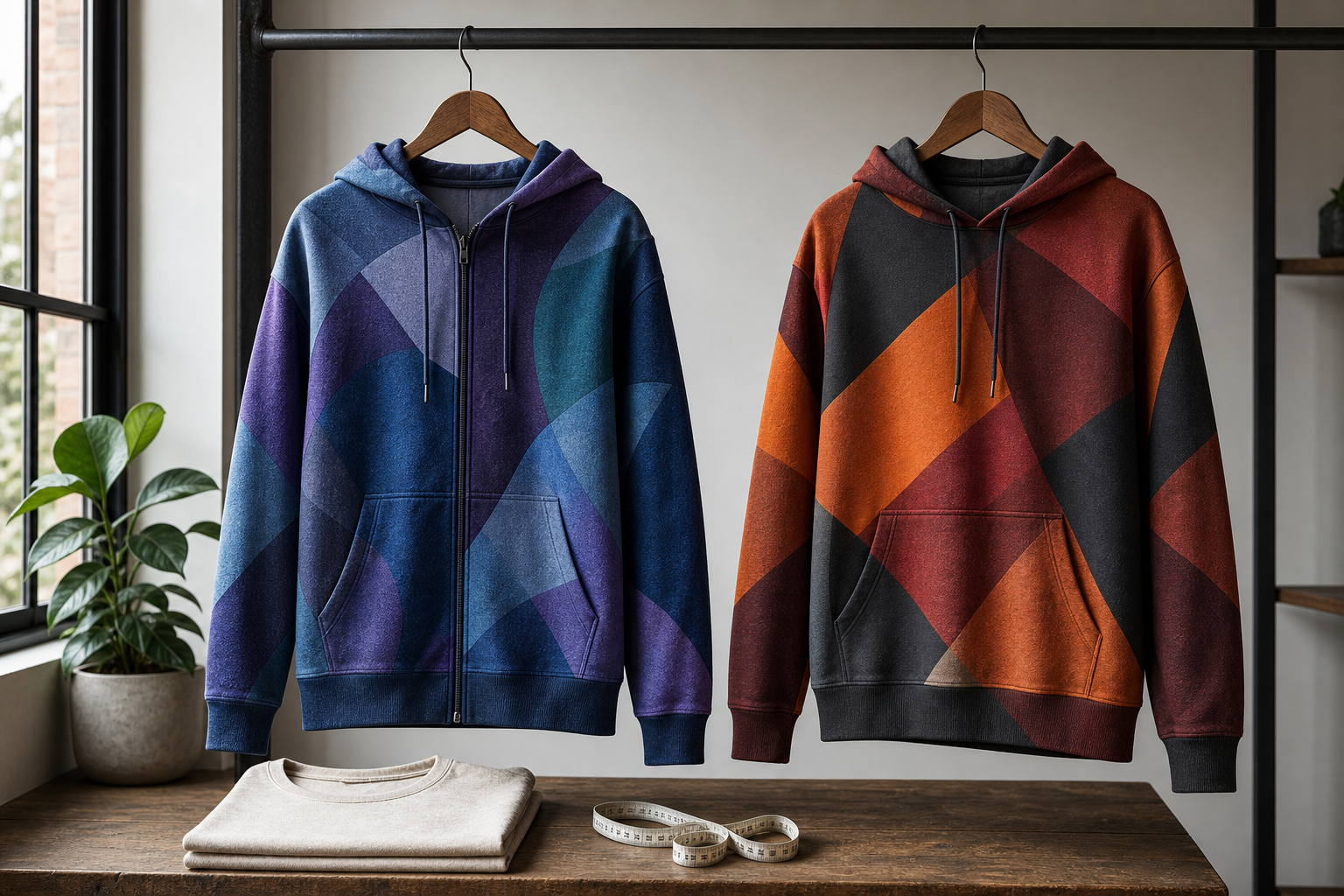
The short answer: choose a zip-up hoodie when you want adjustable ventilation, easy on-and-off layering and the option to wear it open; choose a pullover when you prefer an uninterrupted front graphic and a simpler front without a zipper. Neither silhouette is automatically warmer, softer or more durable. Fit, fibre content, fabric weight, construction and the garment's care label matter more than the closure alone.
My Comfy Hoodie carries both silhouettes in graphic styles. This guide focuses on the practical differences—how to measure, layer, check zipper alignment, assess print placement and care for the finished garment—rather than repeating a general graphic-hoodie styling guide.
Zip-up vs pullover hoodie comparison
| Decision | Zip-up hoodie | Pullover hoodie |
|---|---|---|
| Layering | Opens fully, so a base layer stays visible and temperature is easier to adjust. | Pulls over the head and usually gives a cleaner, continuous front. |
| Graphic placement | The front design may be divided by the zipper and seams. | The front panel can carry one uninterrupted composition. |
| Fit check | Check zipper alignment both open and closed, plus room across the chest. | Check head opening, shoulder mobility and hem movement while pulling it on. |
| Pockets | Often two front sections; verify usable opening and alignment in photos. | Often a central pouch; verify the specific listing. |
| Best practical use | Frequent indoor-outdoor transitions and visible layered outfits. | Simple casual outfits and a continuous graphic statement. |
How should a graphic hoodie fit?
Start with the exact size chart on the current product page. A size name such as medium or “oversized” is not a universal measurement. Measure a hoodie you already like on a flat surface, then compare its chest width, body length and sleeve length with the listing. If the chart uses body measurements instead, follow its method rather than mixing garment and body dimensions.
- Shoulders: the seams should sit where the intended cut places them. A drop shoulder can extend beyond the natural shoulder by design, so use the listing and photos as context.
- Chest: zip the garment fully over the planned base layer. It should close without pulling the print or creating strong horizontal tension lines.
- Sleeves: bend both elbows and reach forward. Confirm the cuff stays comfortable and the sleeve does not restrict ordinary movement.
- Body length: sit, stand and raise your arms. Decide how much coverage you want and check whether the hem returns naturally.
- Hood: try it up and down. Confirm the neckline and drawcord area feel comfortable without assuming the hood is protective weather gear.
If you are between sizes, decide whether your priority is a closer look or room for a tee or light mid-layer. Do not size up automatically: excess fabric can change the placement of an all-over graphic and alter sleeve or pocket position.
How to evaluate a graphic zip-up hoodie
A zipper creates a centre line through the artwork. Look at the product images closed and check whether the two halves of the design meet in a way you like. Pattern matching can vary by design and manufacturing method; do not assume every point will align perfectly unless the listing promises it.
Compare the bold animal artwork of the Tiger Zip Up Hoodie with the two-tone concept on the Fire Ice Wolves Zip Up Hoodie. The Colorful Cat Zip-up Hoodie offers another way a portrait-style design interacts with the centre closure. Use the live photos to assess the zipper line, pocket breaks and print position; product names do not establish fabric performance.
Before keeping a new zip-up, run the zipper slowly while the garment lies flat, then while worn. Stop if fabric catches. Check the slider, teeth, top stop and lower insertion point. A zipper that needs force or repeatedly separates should be addressed under the store's current return process rather than “broken in.”
How to evaluate a pullover graphic
A pullover removes the front zipper, but its graphic can still cross the pouch seam, side seams or folds. Review front, back and detail photos. The Cat Yin and Yang Casual Hoodie provides a pullover comparison to the zip-up animal designs. Confirm the actual closure, fibre content, size range and print placement shown on the live page before ordering.
Test the head opening without stretching it aggressively. When worn over another top, check that the layers move together comfortably. A pullover can feel simpler, but it cannot be opened quickly for ventilation, so the intended climate and indoor setting belong in the decision.
Layering for Canadian seasonal changes
For changing spring or autumn conditions in Canada, build an outfit in removable layers. A light base garment manages the first transition; the hoodie becomes the easy middle layer; a purpose-built outer shell may be needed for wind or rain. A printed hoodie should not be treated as waterproof, high-visibility or protective clothing unless the specific listing provides verified specifications.
A zip-up lets you open the front indoors without removing the entire garment. A pullover keeps the design continuous but generally requires full removal. For travel, classrooms, offices or events, think through coat bulk, backpack straps and how often you will change layers. Confirm that the hood fits under or over other pieces without obstructing vision.
Graphic print care: follow the label first
There is no safe universal wash setting for every printed hoodie. The Competition Bureau of Canada explains that when care information is provided, it must accurately reflect an appropriate method for that article. The U.S. Federal Trade Commission likewise requires reliable care instructions for covered garments. That makes the sewn-in or supplied care label the primary instruction—not a generic online tip.
- Read the label before the first wash and record it if the printing may fade.
- Close a zipper if the label permits machine washing, and empty pockets. This can reduce snagging, but the garment's instructions still control.
- Turn the hoodie inside out only if that does not conflict with its label or trim instructions.
- Use the stated wash, bleach, drying and ironing directions. Do not assume high heat is acceptable.
- Avoid placing a hot iron directly on a graphic unless the label explicitly allows the procedure.
- Wash dark or vivid garments as directed. If the care label warns to wash separately or with like colours, follow it.
The Colorful Flames Print Zip-up Hoodie is a useful example of a high-colour all-over design where checking the exact care label matters. Colour intensity in product photography can also vary by display, lighting and screen settings.
A five-minute arrival audit
- Match the received style and size to the order.
- Read the fibre and care labels; compare them with the live listing.
- Inspect seams, cuffs, pockets, drawcords and zipper components.
- Try it over the intended base layer and repeat the movement checks.
- Review print position in natural light before washing or removing return materials.
Frequently asked questions
Is a zip-up hoodie better for layering?
It is often easier to add, remove or open, but the best choice depends on the planned layers, measurements and setting. Check the exact garment rather than the closure name alone.
Are pullover hoodies warmer than zip-ups?
Not necessarily. Fabric composition, weight, knit, lining, fit and construction influence warmth. A zipper alone does not establish a temperature rating.
Should I size up for an oversized hoodie?
Not automatically. “Oversized” may already describe the intended cut. Compare the listing's measurements with a garment you own and choose based on the look and layering room you want.
How do I keep a graphic hoodie from fading?
Follow the exact care label, including its wash, bleach, drying and ironing directions. No care method can guarantee that a print will never change.
Does a zipper ruin an all-over print?
No, but it changes the composition. Review closed-front photos to see how artwork meets at the centre and crosses pockets or seams.
Bottom line
Choose by routine, not by a blanket winner. A zip-up suits adjustable layering and open-front styling; a pullover favours simplicity and uninterrupted front artwork. Measure first, test movement over the intended layers, inspect print placement and follow the garment-specific care label. Those checks are more useful than unsupported promises about warmth, softness or durability.